
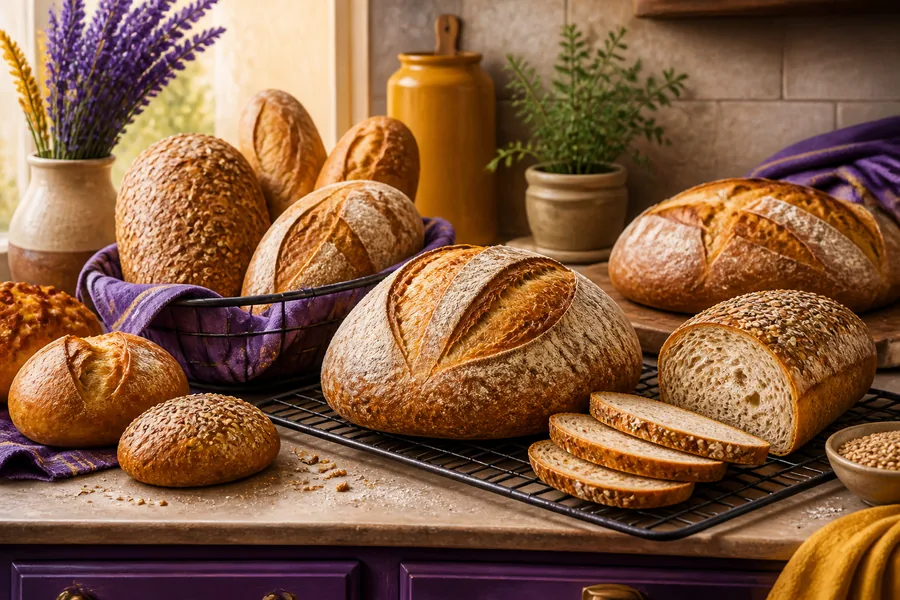
 Illustrative image—not a photograph of this dish. Be the first to upload a real one.
Pain au Levain Naturel
Cookbook | Recipes | Ingredients | Equipment | Techniques | Cookbook Disambiguation Pages | Recipes | Bread
Source: Wikibooks contributors
Adapted: Imported and reformatted by HowManyCookies from the cited Wikibooks revision.
Source revision: Revision 4501606
License: CC BY-SA 4.0 · Wikibooks contributors
Ingredients
Starter culture
- 150 g (½ cup) flour
- Water, warmed
First rise
- 500 g (1 pound) flour
- 300 g (1 cup) water
Final assembly
- About 1.6 kg (10 cups) flour
- 800 g (3¼ cups) water
- 20 g (2 tsp) coarse salt (or 1½ tsp table salt)
Directions
Starter culture
- Three or four days before baking, prepare the starter:
- Mix the flour with a little warm water to obtain a dough that is neither too wet nor too dry.
- Transfer to a covered glass or earthenware container, and let rest at a temperature above 20°C (68°F).
- Allow the culture to stand for 3–4 days, stirring daily with a wooden spoon and adding a little warm water and flour each time.
First rise
- The evening before baking:
- Add flour and water to the yeast culture
- Work the dough for 5–10 minutes with a wooden spatula.
- Cover with a clean cloth and allow to stand overnight at a temperature of about 25°C (77°F).
Final assembly
- If the dough has not risen sufficiently, let stand another 12 hours. When it is ready, save about 3 tablespoons of the dough in the refrigerator as a starter for the next time you make pain au levain.
- Mix the flour, water, and salt into the dough. Don’t incorporate all of the flour—save some to knead the dough.
- When the dough becomes difficult to manipulate in the bowl, work it on a flat surface, adding a little flour as necessary. Knead the dough well for about 20 minutes by pulling and folding but without pressing down on it.
- Cover with a clean cloth and leave to proof for an hour at around 25°C (77°F).
- Divide the dough into 3 balls.
- Oil three baking pans and insert the balls of dough after shaping them to the size of the pan. They may also be baked without a pan—in this case, set them on a baking sheet.
- Cover with a clean cloth, and allow to rise for 2 hours or more at around 25°C (77°F) until the loaves have risen to 1½ to 2 times their original size.
- When the loaves have risen, cut diagonal incisions along the length of the loaves with a razor blade.
- Preheat the oven and bake at 260°C (500°F) for ½ hour. Lower the heat to 200°C (400°F) and bake for another ¼–½ hour. Two thirds of the way through baking, sprinkle the loaves with cold water and continue baking. This will give a shiny surface.
- Remove from the oven and let cool.
Notes
Suitable flour types include complete 110 (high-gluten bread flour) or half-complete type 80 (all-purpose flour).
It's best to use chlorine-free water, as the chlorine is bad for the yeast.
In an oven with uneven heat distribution it may be necessary to move the loaves around halfway through baking.
The bread will keep for one week.